
Neuromatch mentors.

During the Academy, students get professional development mentorship.

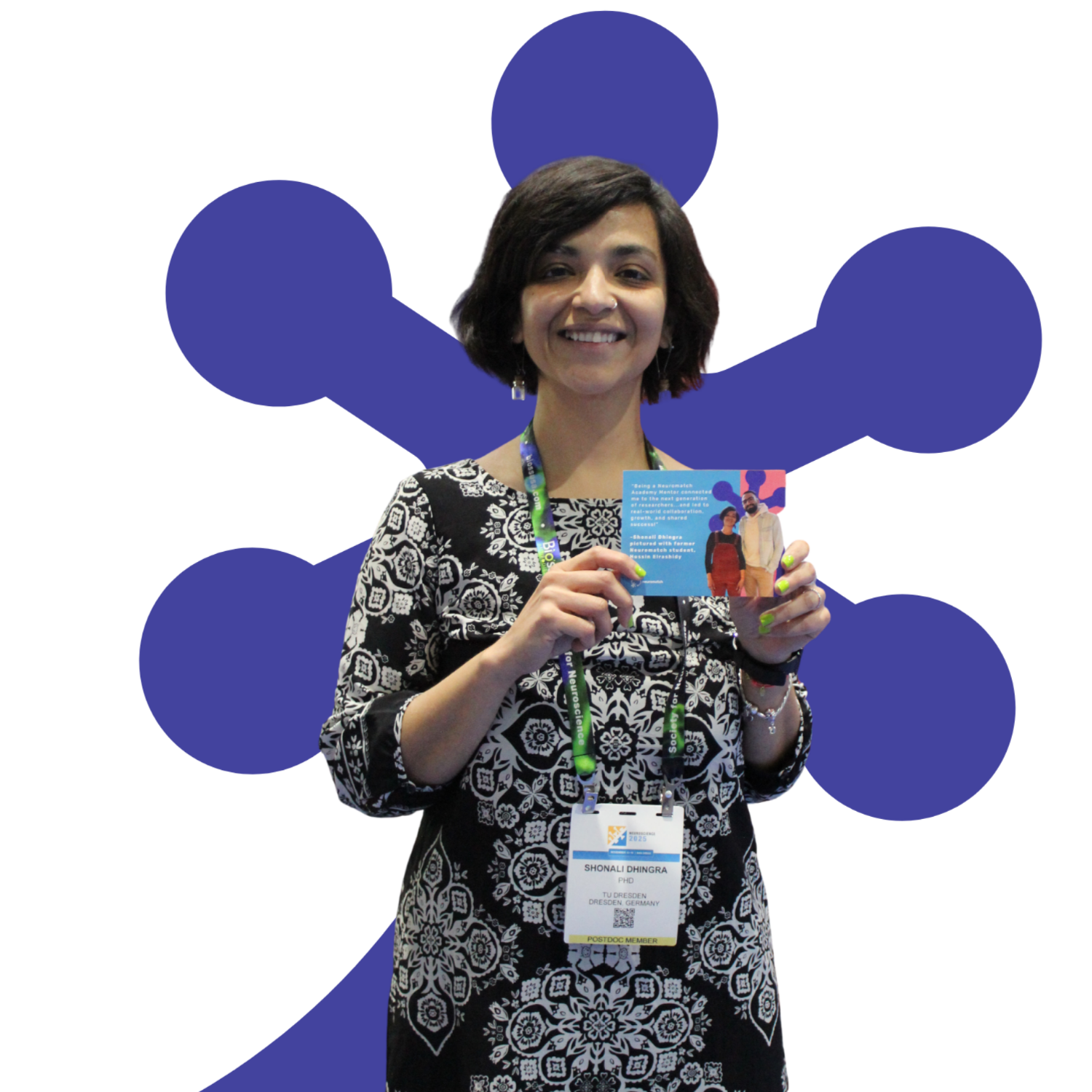
Mentors bring more than knowledge; they bring guidance, connection, and opportunity. Across institutions and disciplines, our mentors share their broader experience and career insights, helping students chart a path forward in computational science. Many students say that connecting with their mentor is one of the most meaningful aspects of their journey.
What experience should a mentor have?
Mentors should have experience with research and hold a PhD (or equivalent experience)
What is the time commitment?
For Computational Toole for Climate Science and NeuroAI it is 3 30 minute meetings over 2-weeks for a total of 1.5 hours. For Computational Neuroscience and Deep Learning it is 5 30 minutes meeting over 3-weeks for a total of 2.5 hours.
What does the mentor do during the meeting?
No preparation is required! You can talk about your broarder experience and answer questions. You can share general career advice with students as well. Students will also be working on group projects so it's also an opportunity to share research best practices.
What's the application process like?
Mentors will first choose which courses they'd to be a mentor for: Computational Neuroscience, Deep Learning, NeuroAI, or Computational Tools for Climate Science. We'll ask you questions about your time zone and background to make sure we match with a pod of students that would benefit from your mentorship.
When do I find out if I'm a selected mentor?
About a week before the course, you’ll receive an email letting you know which project group you’ll be mentoring. This email will include the group’s Teaching Assistant. You’ll work with the TA to schedule a meeting during the first week of the course, during the group’s dedicated project time. There are some cases when we have too many mentors! If we are not able to match you with a group, we will let you know and have you as a backup. There are always groups that need new mentors during the course.
What should I know about the logistics?
You’ll schedule a total of 3 meetings for a 2-week course and 5 meetings for a 3-week course. Each meeting should be about 30 minutes. You’ll work with the TA to schedule the first meeting, and then communicate directly with the group to schedule the rest. All meetings take place during the group’s project time. All meetings take place via Zoom. You’ll receive a link to join our Discord Server where you can chat with your group directly. Please open a Support Ticket and let them know you’re a mentor and which group you are working with.
What are some tips for being a mentor?
Set clear expectations to ensure that you and your mentees are aligned and working towards common goals. Practice active listening and show genuine interest in your mentee’s perspectives. Provide constructive feedback and frame it in a way that encourages growth and learning, rather than discouragement. Encourage self-reflection. Share your experience. Share both successes and failures to provide a realistic perspective on the path ahead. Maintain professionalism and ethics in your interactions
2025
Aahana Bajracharya, Abdul Rauf Anwar, Aharon Ravia, Ahmad Samara, Ahmed Nebli, Alberto Antonietti, Alex Attinger, Alireza Khanteymoori, Alireza Karami, Allie Karshenas, Amritpal Singh, Andrea Navas-Olive, Anh Nguyen, Anjani Chakrala, Ankit Sharma, Aparajeeta Guha, Araceli R. Cardenas, Arezoo Alizadeh, Arvind Kumar, Aslan Satary Dizaji, Atul Gopal, Aya Lahlou, Bahareh Najafi, Bashir Dodo, Belfin Robinson, Bharath Talluri, Bhargav Nallapu, Boaz Mohae, Bryan Daniels, Caitlin Lienkaemper, Cheng Xue, Dan Butts, Daniel Hagan, David Quiroga-Martinez, David Pruitt, Deborah Barany, Dhananjay Bhaskar, Diksha Gupta, Dimitra Maoutsa, Dimitris Pinotsis, Dominik Endres, Efstathia Soufleri, Ercu Gorgul, Erdem Varol, Erdost Yildiz, Ethan Kyzivat, Evgenii Tretiakov, Eviatar Yemini, Farzaneh Najafi, Fernando Julian Chaure, Florencia Altschuler, Gal Haspel, Gal Vishne, Gyorgy Lur, HaDi MaBouDi Hemanth Manjunatha, hosein Moazen, Huriye Atilgan, James Kirby, Jeff Johnston, Jens Tillmann, Jeremy Manning, Jesse Parent Jiaxin (Cindy) Tu, Jitender Kumar, Jonathan Beagan, Jonathan Cannon Joshua Glaser, Juan Salvador Calanni, Kamal MAlik, Kayson Fakhar, Koissi Savi, Kshitij Kumar, ladan shahshahani, Lema Logamou Seknewna, LIDIA GHOSH, Lieneke Janssen, Linda Katona, Margarita Zachariou, Matthijs Oude Lohuis, Mayank Mehta, Milan McGraw, Misun Kim, Modupe Odusami, Mohamed Hédi Riahi, Mohammed Alatiyyah, Mominul Ahsan, Natasha Clarke Nayan Anand, Neeraj Upadhyay, Nibras Abo Alzahab Nina Kudryashova, Olushina Olawale AWE, Pandurang Choudhari, Pankaj Pandey, Parviz ghaderi, Paul Miller, Pratik Purohit, Priyanka Ghosh, Qihong Lu, Ramon Bartolo, Robert Nickl, Romain Cazé, Sandhya Prabhakaran, Sandra Gomes, Sankar Alagapan, Sarah Ruediger Selva Maran, Shivesh Chaudhary, Shonali Dhingra, Simone Russo, Sohail Siadatnejad, Soon Ho Kim, Subhankar Mishra, Suniyya Waraich, Suranjana Pal, Sushovan Ghosh, Swapnil Kumar, Swati BANERJEE, Tatia Buidze, Theodrose Hailu, Tony TONA LANDU, Tosif Ahamed, Tsvi Achler, Vinícius Carvalho, Vinod Kumar Jangir, Vladimir Litvak, Weronika Wojtak Xihe Xie, Yu (Andy) Huang, Zeynep Enkavi.
2024
Aaron Wienkers, Adeel Razi, Aderonke Thompson, Ahmad Samara, Ahmed Nebli, Ahmed Shaheen, Aicha Mustapha, akihiro yamaguchi, Akshara Vaithiswari Gopiswaminathan, Alberto Antonietti, Alireza Karami, Aman Pandey, Amirmohammad Shamaei, Andres de Vicente Donderis, Andy Alexander, Andy Liu, Anthony Strock, Apoorva Karekal, Araceli Ramirez Cardenas, ARUNA S K, Asim Muhammad, Atul Gopal, Avgusta Shestyuk, BILIKIS ALEGE-IBRAHIM, Boaz Mohar, Bradly Alicea, Brian Xu, Bryan Daniels, Cameron Aaron, Carsen Stringer, Chathura Ranasinghe, Ching-Lung Hsu, Claudia Boehm, Daniel Hasegan, Daniel Polyakov, Daniel Rothenberg, David Lafferty, Diana Rotaru, Dieter Jaeger, Dilip Rajeswari, Dominik Endres, Doris Santiago, Doyinsola Afolabi, Els Van der Helm, Enny van Beest, Ercument Gorgul, Ethan Kyzivat, fariba naeiji, Farzaneh Hatami Nezhad, Gandy Rosales Quintana, Gautam Sathe, Gizachew Agegn, Grant Vousden-Dishington, Guangyao Qi, Hamidreza Jamalabadi, Hannah Douglas, Hayami Nishio, Hitesh Dammu, Hossein Adeli, Ilenna Jones, Ingrid Nieuwenhuis, Iqra Shahzad, Ivy Chen, Jakob Kaiser, Jason Ritt, Jean-Paul Noel, Jeffrey Lopez-Rojas, Jesse Parent, Jorge Otero-Millan, Jose Guzman, Julian Kosciessa, Katharina Dobs, Kay Kozaronek, Kayson Fakhar, Kirill Korotaev, Kristijan Armeni, Krzysztof Basiński, Kshitij Dwivedi, Landan Mintch, Lidia Huaman, Linda Iris Joseph Tomy, Lukas Vogelsang, Madineh Sarvestani, Manasa Gudimella, Marek Miltner, Margarita Zachariou, Matteo Moro, Matthias Aengenheyster, Md Shahriar Tasjid, Mohammad Sohaib, Morteza Mahdiani, Nabasmita Phukan, Nagaraj Mahajan, Naina Goel, Nanda Harishankar Krishna, Naoki Hiratani, Nayanika Biswas, Neeraj Kumar Sharma, Nelson Ndugu, Nick Halper, Nima Amiri, Nuttida Rungratsameetaweemana, Olalekan Akintande, Olushina Olawale Awe, Oranatt Chaichanasittikarn, Ozgur Ege Aydogan, Pankaj Pandey, Peter Rupprecht, Prakash Chaudhary, Prashant Shukla, Raha Dastgheyb, Raymond Chua, Richa Tripathi, Rocío Caballero-Gill, Saidat Rasaq-balogun , Sana Motallebi, Sandra Gomes Sankalp Sharma, Sara Ahmadi Majd, Sara Monteiro, Sarah Ruediger, Saurabh Gandle, Scott Cole, Shalom Thilagarajan, Siddharth Gupta, SOHAM BANDYOPADHYAY, Soroush Fazel, Soumilee Chaudhuri, Subhankar Mishra, Swati BANERJEE, Tahir Alaka , Tahra Eissa, Taiga Abe, Takuya Ito, Thanos Tsigaras, Theresa McKim, Tong Liang, Wenhiu Zhao, Weronika Wojtak, Xiaoge Bao, Yuqing Zhu.
Apply to be a mentor

Current recruitment is closed. We will open applications in April or May.

Enthusiasm to the max
Mentoring is a great opportunity to have someone with more professional and academic experience advise you on your journey. It is a learning and networking opportunity, at which you may find someone to look up to, to collaborate with or just from which to draw off more passion to follow your own path.
Be sincere to yourself and to your mentor
It is best to have expectations clear and refined. Your first session might initiate with getting to know each other, where you are at the moment and where you want to get in the mid and long run. In the session, each one should make clear what they expect, reshape those expectations to be realistic and useful, and find a dynamic that benefits all parts.
Self-knowledge
You are not expected to know everything about your professional interests, but rather it is important for you to have a clear picture of where you are at the moment, and maybe a rough idea of what you want to achieve. Being conscious of your current state will help you get the best advice possible for you.
Keep a respectful and warm tone to the conversation:
Even though it has a professional tone to it, mentoring is, in essence, a social interaction. You may construct a long-lasting relationship with either your mentor or your peers (or both!). Thus, be kind and have fun, as you’ll be discussing your dreams and career goals, as well as the efforts you’ve made so far to follow them.
Some planification
On one hand, you might want to have a rough drawing of what you might want to talk about during your mentoring sessions. It could range between your worries on how to apply to grad school, lab experience, and finding collaboration opportunities, among other things. This will facilitate you having a base from which to talk to, rather than trying to come up with something on site.
Flexibility is key
On the other hand, planning beforehand shouldn’t mean wanting to follow everything you imagined. Depending on the dynamics in the mentoring room, you might not be able to talk about everything you wanted to, or you might’ve talked about things you didn’t even consider before. Feeling like you’re being pushed out of your comfort zone might be a common thought during those sessions, so it might be best to adapt and maximize your learning out of it.
Own your actions
A mentor is there to help you find some insight, but not to solve the problems you presented yourself. In some cases, help might come as just verbal advice. In other cases, they might give you resources (books, links to institutes or emails of peers whom to contact). But in the end, you must take action based on this advice, your interests and capabilities. If you have doubts about the actions you have to take, that might also be a topic of discussion with your mentor.
Notes, work and repeat
During or after your mentoring session, you might want to write some notes down on what was said that will be of interest. After that, try to make changes that correspond to the advice that was given to you, so that when you meet up again with your mentor, you can provide some advances to them.